Interest in plant-based omega-3s continues to grow, driven by sustainability and changing dietary preferences. But expectations are high: any plant-derived source must show that it can support the same key metabolic pathways long linked to marine EPA and DHA. The question is no longer simply whether a vegan option exists, but whether it can deliver comparable or distinct functional benefits.
With this in mind, ImperialOel — exhibiting partner at the 24th Annual Dietary Supplements Conference 2025 — sat down with Natures Crops International, the pioneer behind Ahiflower®, the “hidden champion” of plant-based omega-3s.
Oliver: When people look at omega-3 supplements from the outside, it may seem as if there isn’t much new to discover anymore. Omega-3s have been around for so many years. But in fact, especially in the field of plant-derived omega-3 oils, there’s still a lot of innovation happening.
What do you think, Greg?
Greg: Absolutely. And the interesting part is how it’s different from the typical plant sources that most people already know — particularly when it comes to their alpha-linolenic acid (ALA) profile and the availability of eicosapentaenoic acid (EPA).
Oliver: Exactly. For decades, plant-based omega-3s such as flaxseed oil have been the most familiar vegan sources of ALA — an essential fatty acid that we must obtain from our diet. However, it has long been understood that our bodies convert ALA into EPA and docosahexaenoic acid (DHA) only to a very limited extent. That’s why fish oils remain the dominant omega-3 source today.
The breakthrough with Ahiflower® : It unlocks a far more efficient pathway to EPA
The breakthrough with Ahiflower® oil is that it unlocks a far more efficient pathway to EPA — thanks to its naturally high content of stearidonic acid (SDA). SDA converts to EPA up to eight times more efficiently than ALA and supports the body’s own production of DHA. While older studies mainly looked at blood levels, more recent whole-body studies show that DHA conversion and storage in body fat and the liver are up to 48 times higher — which is quite significant for plant-based nutrition.
But I think, Greg, you can explain best what makes Ahiflower® so unique.
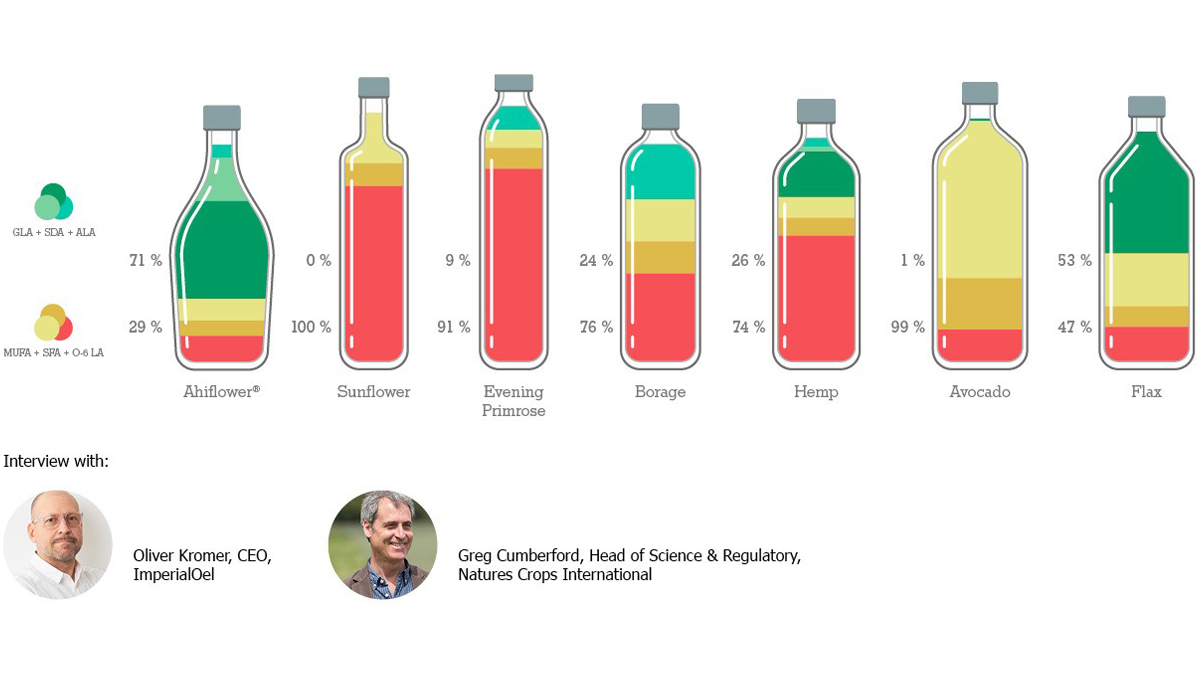
Greg: Sure. Ahiflower® seed oil originates from a plant in the borage family, Buglossoides arvensis. It contains about 45% ALA, similar to flaxseed oil, plus 6% gamma-linolenic acid (GLA) — an omega-6 fatty acid with anti-inflammatory, hormone balancing properties — commonly found in evening primrose oil. Flax, fish, and algal oils contain no GLA. Ahiflower® oil’s high ALA and 20% SDA content makes it nature’s richest source of omega-3. SDA is biochemically quite active and has similar anti-inflammatory properties as EPA and DHA, plus some newly recognized gut microbiome balancing and GI-tract calming metabolites. Our bodies convert Ahiflower® oil’s ALA and SDA to long-chain omega EPA and DHA effectively, as shown in many human and animal trials. Ahiflower® oil is the most complete and balanced omega-369 from a single plant. And it has a clean, neutral taste.
Oliver: That’s why we see it as a real game changer for plant-based omega-3s. It allows consumers to support long-chain omega nutrition from a fully plant-based source
Since SDA content is such an important part of that story, Greg, would you consider it one of the unique features of Ahiflower®?
Greg: Yes, absolutely — that’s actually one of the key differentiators. The SDA level in Ahiflower® is significantly higher than in other well-known sources — nearly twice that of echium and about ten times that of black currant and hempseed oils. And beyond its unique composition, Ahiflower® also addresses increasingly important factors of sustainability and traceable origin.
Ahiflower® also addresses key aspects of sustainability and traceable origin
Ahiflower® oil is certified non-GMO and farmed following regenerative farming practices in England that promote pollinator and soil microbial biodiversity. Starting more than 20 years ago at Natures Crops International, we have been screening numerous plant varieties following natural selection and conventional plant breeding to identify certain strains of Buglossoides arvensis with the highest overall SDA and GLA content, the most climate resilience and soil health value, and best oil yields.
Oliver: Those are exactly the kinds of aspects that matter for a product to meet the expectations of the European market — where we’ve only very recently started to promote Ahiflower® oil. The first customer launches include pure Ahiflower® oil in vegan softgels and in bottled blends combining algal DHA with Ahiflower® oil, which provides SDA, ALA, GLA, and OA (oleic acid) – a very compelling blend in our view.
Natures Crops International’s operations are headquartered on Prince Edward Island in Canada, which is why the company’s initial focus has been on the North American market. Greg, perhaps you can share a few words about your company and its background?
Greg: Sure. Here in North America, Natures Crops have established a solid and rapidly growing position with more than 80 health supplement and food/beverage products containing Ahiflower® oil, including in formulations for horses, dogs, and cats — all taking advantage of Ahiflower® oil’s clean taste and aroma appeal that comes naturally from its higher oxidative stability compared to fish and algal oils. Kids, seniors, and dogs all love Ahiflower® oil! As a result, many human and companion animal nutrition brands are discovering the advantages of Ahiflower® as a sustainable, plant-based omega source with no trade-offs in meeting the body’s EPA/DHA needs.
Graphics and Video credits: www.bjoernschmitz.com. Headshots credits: Natures Crops International, ImperialOel