
Artikel aus dem Handelsblatt Journal Government Technology
Digital technology is the infrastructure of modern economies, the backbone of military operations, and the medium through which democratic societies are increasingly attacked. It is where all of Europe’s vulnerabilities converge, and where the continent is most dangerously exposed. Whoever controls digital infrastructure controls security, competitiveness, and democracy. Today, that is not Europe.
Germany, as the EU’s largest economy and its industrial engine, is at the centre of this challenge. The German government and the broader European public sector are structurally dependent on foreign digital infrastructure. Over 80 percent of Europe’s digital technologies are imported¹. Three American hyperscalers control roughly 70 percent of our cloud market, hosting sensitive government, health, financial, and industrial data. Less than 4 percent of global AI training capacity sits in Europe. We are renting the digital nervous system of our democracies from powers that increasingly treat infrastructure as a tool of coercion.
Dependency is no longer an abstract debate
The events of the past months have made this brutally concrete. Denmark announced it would remove Microsoft from its public IT systems, not in a vacuum, but while Washington was openly pressuring Copenhagen over Greenland. Denmark’s digital minister was explicit: “We must not make ourselves so dependent on so few that we can no longer act freely.” That is a government understanding, in real time, what digital dependency means when geopolitics turns hostile.
The pattern extends beyond Denmark. The US administration imposed visa bans on a former European Commissioner and civil society leaders for implementing EU digital regulation, turning the enforcement of European law into grounds for personal sanction. Ukraine depends on Starlink on the battlefield: one private billionaire decides whether an army can communicate. The US Cloud Act requires American companies to hand over data to Washington, even when stored on Servers in Frankfurt or Munich. From Beijing, rare earth xxport controls were suspended as part of a US–China deal, not because of European leverage. We were bystanders in a negotiation over our own supply chains. Without strategic autonomy, Europe is not at the table. It is on the menu.
The new techno-political order
Cloud, chips, data, and AI have fused with economic, military, and political power. The United States has placed semiconductors and AI at the centre of a new security doctrine. China expands its industrial AI strategy at extraordinary speed. ASML, a European company, holds a monopoly on the lithography machines the entire global chip supply chain depends on, yet operates within a US-led export control regime, not a European one. We possess strategic assets but do not control the rules under which they operate.
Europe risks being a pawn between two empires. The fusion of Big Tech and state power in the United States is no longer a matter of lobbying, it is structural². Technology companies sit at the centre of defence, intelligence, and economic policy. Palantir runs core Pentagon and State Department infrastructure. At least ten undersea cables have been sabotaged in the Baltic since 2023, cables that carry 99 percent of intercontinental communications, and Europe has no coordinated capacity to protect them. This is not an adversarial reading of an ally, it is a sober assessment of where power now lies. For Germany, which hosts some of Europe’s largest US-operated data centres, the implications are immediate.
What EuroStack is, and what it isn’t
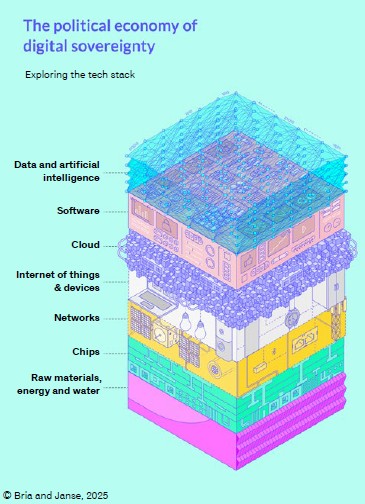
EuroStack³ is a strategic framework for European digital independence, identifying where sovereignty must be secured: cloud and AI infrastructure, digital identity and payments, open-source alternatives, semiconductors, and satellite networks. The goal is not protectionism, it is ensuring that critical infrastructure is governed by European law and operated in European interest.
The political momentum is real. Over 250 companies support EuroStack. Germany’s new coalition agreement explicitly embraces the initiative and commits to a sovereign Germany Stack compatible with European systems. The European Parliament adopted the technology sovereignty report. The Competitiveness Compass aims to mobilise a trillion euros, following Draghi’s report recommendations. But momentum is not delivery. Now words must become action.
What It Means for Germany’s Public Sector
For Germany’s federal, state, and municipal administrations, this is not abstract geopolitics, it is an operational question. Flagship modernisation efforts depend on infrastructure choices being made right now. If those choices Default to American hyperscalers, Germany will digitise its state on someone else’s terms. Every Land, every Kommune that migrates to a proprietary US Cloud creates a lock-in that will be extraordinarily difficult to reverse. German providers, such as StackIT, Dataport, IONOS, OVHcloud, are GDPR-native, AI-ready, and aligned with European law. What they lack is not capability but demand. The new Digitalministerium has the mandate to change this.
Three levers for Transformation
First: a Buy European strategy for public procurement. At least 50 percent of public-sector digital spending should go to European providers by 2030. The EU spends two trillion euros a year in public procurement, the most powerful industrial policy lever we have. Yet 30 percent of European investment flows abroad. We are financing our own dependency with taxpayers’ money.
Germany, with its new Digital Ministry, can lead the way. Second: a European Sovereign Tech Fund of at least €100 billion for AI Gigafactories, semiconductor production, and deep tech. The state must become an investor and entrepreneur, taking strategic stakes in critical companies. This is our Airbus moment for the digital age. Without patient public capital, without leveraging private capital and mobilising institutional investors, our most promising companies will keep scaling on foreign infrastructure or exiting abroad.
Third: rapid deployment. Sovereign cloud for the public sector. European digital identity. The digital euro. Industrial data spaces. Open-source AI models in key industrial sectors. DeepSeek has shown that breakthroughs don’t require infinite resources. Open source prevents vendor lock-in, lowers costs, and creates scale without monopoly. But deployment must also mean speed. Europe needs ARPA-style innovation challenges that set ambitious targets, mobilise our best innovators, and drive fast iteration from prototype to production. Innovation procurement, not traditional tendering, must become the norm, so that sovereign technology is deployed at the pace the moment demands.
AI: Europe’s Moment, Germany’s Strength
Europe won’t build the next ChatGPT. But that’s not where the real game is. The real game is AI adoption and diffusion, and here Europe has competitive advantages no other region can match. Our industries generate data of the highest quality: advanced manufacturing, precision mechanics, automotive, pharma, robotics, clean energy. The EuroHPC supercomputers are among the most powerful in the world. AI Factories and Gigafactories can provide green compute, clean energy, and datasets. Industrial AI, robotics, automation, digital twins, is our terrain. Without our own models trained on European industrial data, we are permanent customers of others’ intelligence.
Germany’s strengths are enormous: semiconductor production in Saxony, automotive engineering in Baden-Württemberg and Bavaria, pharmaceutical innovation, world-class robotics. Mittelstand companies generate industrial data of a Quality that exists nowhere else, the raw material for the next generation of AI. Across Europe, similar clusters are emerging: in Emilia-Romagna, where I lead the regional innovation agency, we connect Motor Valley, food, and advanced manufacturing industries with an AI Factory on the EuroHPC network. The model is the same: sovereign compute linked to industrial excellence, rather than handing our most valuable data to foreign platforms. And unlike the extractive model of Silicon Valley, Europe can ensure that the gains from AI are shared with the workers and communities who generate the data and operate the systems, building on traditions of social partnership that are themselves a competitive advantage.
A political project
If Europe fails, we will regulate technologies developed elsewhere, hosted on infrastructure we don’t control, shaped by values we didn’t choose. We built a Union of laws, rights, and markets. We built the euro. We are completing the Single Market. But we are missing the Digital Union.
Now is the moment to bring home the talent and the entrepreneurs who left to raise capital and build companies elsewhere. With academic freedom and public research under threat in the US, Europe has a rare opportunity. We must become the place where the best want to build. Choose Europe.
If EuroStack succeeds, Europe proves that democracy can build the future, that there is a third path to offer to the world between the monopoly capitalism of American Big Tech and the state centralism of China.
In the twenty-first century, if you don’t control your technology, you don’t control your economy. And if you don’t control your economy, you don’t control your democracy. In 1950, the Schuman Plan united coal and steel to build peace. In 2026, we must unite compute, AI, and chips to secure our democratic future. EuroStack is not merely a technology proposal, it is a political project, as necessary as the single currency or the single market once were. Another Stack is possible, to defend our freedom, prosperity and democracy.
¹ https://www.euro-stack.info/#report
² https://www.authoritarian-stack.info
³ https://www.euro-stack.info