

Europe today faces a security policy challenge unlike any it has seen since the Second World War. While rising defense spending in many member states demonstrates political will, money alone is insufficient to guarantee credible and long-term deterrence. A holistic approach is needed, one that combines industrial strength, innovation, societal resilience, and political leadership, and that adapts to the evolving rules of modern warfare.
More than just higher defense spending
Since the annexation of Crimea in 2014 and Russia's war of aggression in 2022, the geopolitical landscape has changed dramatically. At the same time, a strained transatlantic alliance has forced Europe to rethink its defense strategies. The reactions are palpable: Germany has established a multi-billion euro special fund, France is considering spending up to 5 percent of its GDP, the United Kingdom aims to reach 2.5 percent by 2027, and the EU could mobilize up to €800 billion with its "Readiness 2030" plan.
Germany has ushered in a "turning point" with the aim of reducing defense spending within to almost triple in seven years. 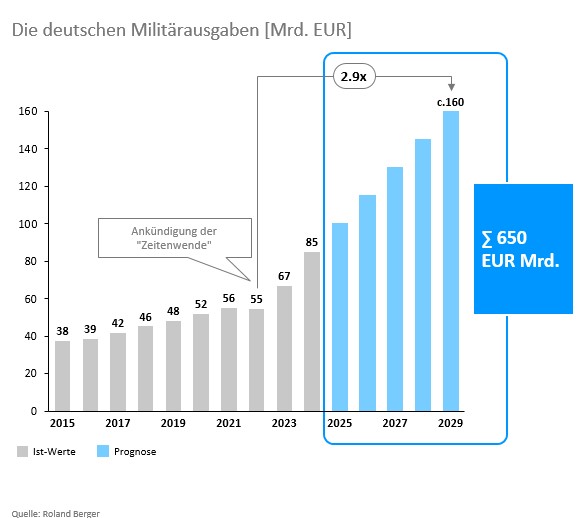
Seven key areas of action for Europe's security
These financial commitments are an important signal, but what will be crucial is how quickly and efficiently they are translated into real capabilities. At Roland Berger, we have identified seven key areas of action for this:
- European defence cooperation – Joint procurement and coordinated strategies.
- Innovation, Research & Development – Promoting new technologies and skills.
- Industrial capacities – Expansion of flexible and scalable production facilities.
- Troop strength – Ensuring sufficient and well-trained personnel.
- Adapting to new warfare – Response to hybrid and digital threats.
- Access to strategic pioneers – Securing critical technologies and resources.
- Societal resilience – Strengthening infrastructure, civil protection and societal readiness.
The industrial base as a key
In addition to the geopolitical situation, the threat landscape has also changed significantly. Traditional military scenarios are now complemented by cyberattacks, information warfare, and economic coercion. Therefore, Europe needs a flexible, technologically advanced defense structure capable of responding to this complexity.
A crucial lever lies in the industrial base. Relying solely on conventional defense production is too slow and too expensive, and carries the risk of overcapacity once crises subside. Therefore, we envision a hybrid approach: expanding production capacities in peacetime, modernizing existing facilities, strategically integrating civilian industries to address bottlenecks, and creating high-volume, cost-efficient manufacturing capabilities. This will allow Europe to react more quickly while simultaneously operating more sustainably.
Cooperation as a prerequisite
For this approach to be effective, political decision-makers, the military, the defense industry, and the civilian sector must work closely together. Clear roles, coordinated processes, and a shared strategic vision are crucial for rapidly expanding capabilities and ensuring deterrence.
The challenge is immense, but the resources are available. By pooling its resources, Europe can strengthen its industrial leadership and lay the foundations for a credible, sustainable deterrent. Time is of the essence, but history shows that the continent often demonstrates its greatest strength in times of crisis. With unity, determination, and a spirit of innovation, Europe can not only secure its security but also pave the way for a stable future.
Cover image: © fritz@faceland.com