

The next five years are already mapped out in terms of climate: According to the World Meteorological Organization (WMO), exceeding the 1.5-degree threshold by 2029 is almost certain. Heatwaves, heavy rainfall, supply disruptions, water shortages, and health risks will become part of economic reality. Companies must prepare—not someday, but now.
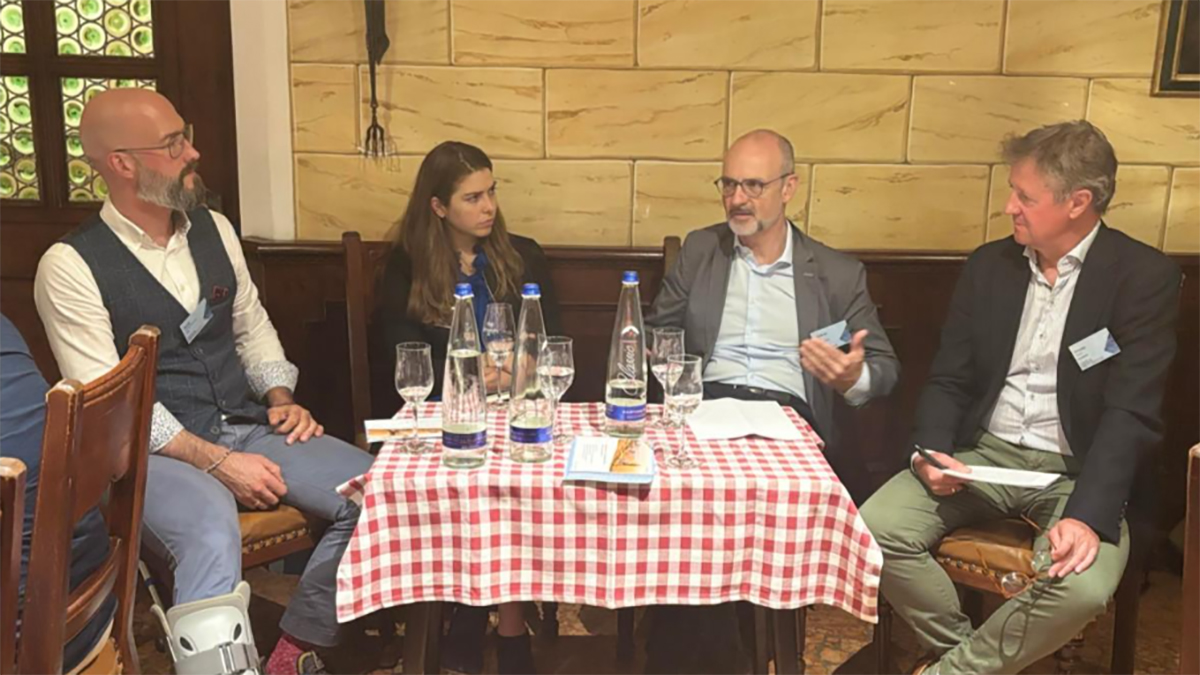
In the historic Bacchus Cellar of the Munich Town Hall, experts and executives discussed the challenges of climate adaptation:
- How do we identify the critical vulnerabilities in our value chains?
- How do we strengthen adaptability?
- And how can collaboration with suppliers, employees, and investors succeed in a new risk reality?
Three Perspectives – One Topic: Strategic Climate Resilience
Dr. Lena Fuldauer, Global Sustainability & Resilience Solutions Lead at Allianz Commercial, emphasized how insurers can actively support their clients in adaptation and increasingly take on a proactive role as partners in resilience. Many companies already have established risk management systems but need additional data to understand how risks and resilience needs will evolve. The key takeaway: Even in times of uncertainty, action is required – action that strengthens both resilience and sustainability.
Dr. Andreas Wagner, Chief Sustainability Officer at HypoVereinsbank, highlighted that SMEs in particular need more guidance and information to implement meaningful adaptation measures. Banks not only offer the right financing instruments but can also provide targeted knowledge and funding options. Moreover, new business models are emerging—especially where companies proactively invest in resilience.
Daniel Schmitz-Remberg, founder of DSR & Partners – Climate Adaptation Advisory, illustrated the importance of embedding the topic within management to enable effective action. Depending on the industry and prior experience, the starting points can vary widely. The range of available solutions—from cooling vests to risk data and early warning systems—is far greater than many realize. He called for a new kind of hope in the face of climate change: the hope that we can now better adapt and protect people and value chains.
From Sustainability to Concrete Climate Risk Management
The discussion made one thing clear: Many companies are already active in decarbonization – climate balances, Scope 1–3, and CO₂ targets are well known and established. But the physical side of climate change – heat, drought, flooding, supply disruptions – is still abstract for many. Participants recognized that climate adaptation is more than an add-on – it requires a distinct perspective on processes, locations, employees, and capital flows.
A defining image of the evening was the shared look into the “engine room” of banks and insurers: Here, systematic assessment of physical climate risks is already underway – with data models, forecasts, adaptation pathways, and clear requirements for clients. Companies that invest in adaptation improve their insurability and long-term financing prospects – a message many heard clearly for the first time that evening.
A positive note: Especially in SMEs, adaptation may progress more quickly due to fewer legacy structures and sustainability bureaucracy. Where adaptation is seen as a business opportunity, there is room for pragmatism, innovation – and competitive advantage.
Resilience Is Not a Cost Driver, but an Investment Logic
The evening also underscored: The economic logic of climate adaptation is already established. Studies like the “Inevitable Investment Opportunity” paper by Singapore’s sovereign wealth fund (GIC) or recent WRI analyses show: Every euro invested today in protection, prevention, and adaptation saves multiple times that amount in future damages and follow-up costs. For investors, a company’s adaptability is increasingly becoming a hard selection criterion. Much will change here, as 98% of resilience investments currently come from the public sector. Companies are being called to act.
Whether cooling vests for employee protection, climate-resilient buildings, early warning systems for heavy rainfall (think Texas), resilient logistics, adapted agriculture, or decentralized water treatment – solutions are not lacking. The challenge lies in integrating these solutions into daily business operations, financing them strategically, and recognizing them as strategic assets.
Taking Responsibility in Climate Change Also Means Adapting
The roundtable in Munich was not a panel discussion, but an open, high-level exchange among equals. The key insight: Climate adaptation is not an extension of sustainability—it is an independent leadership task in dealing with unavoidable changes.
The Handelsblatt Conference “Corporate Climate Adaptation” will continue this path: with companies that take responsibility – and with solutions that make a difference.