

Notes from our joint Handelsblatt & Adaptation Exchange roundtable (Sept 3, Hamburg)
At a glance. Third roundtable of the series after Paris and Munich, hosted by ERM in the HafenCity, Hamburg. A curated group from industry, logistics, finance and the resilience ecosystem advancing adaptation. Together.
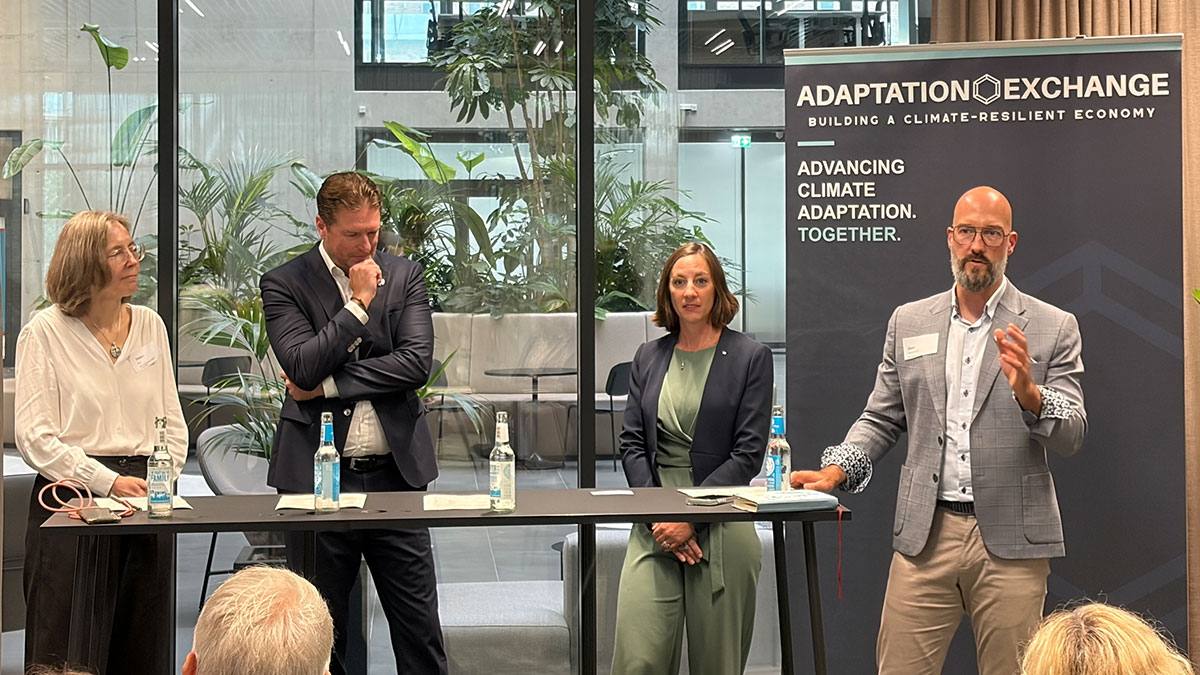
On the panel. Dr. Mirjam Peters, Chief Customer Sustainability & Regulator Affairs Officer Höegh Autoliners Axel Franck, Partner at ERM. Christiane Hahn, Chief Medical Officer at Airbus. Moderated by Daniel Schmitz-Remberg, founder of the Adaptation Exchange.
Three insights. The large disruptions in a supply chain often rest on a very individual base, because heat takes concentration before it takes anything visible.
In severe weather, the safety of crews and vessels comes before the schedule; long-term reliability depends on disciplined decisions under uncertainty. Responsibility runs the whole length of an organisation, and what lets every level carry its share is a resilience culture: seeing, understanding, convincing, enabling, and the courage to act.
Intro
Hamburg gave us the clear light of an early autumn evening. Our host was ERM, founding member of the Adaptation Exchange, with the harbour spread out below and the Elbtower directly in view. The tower stands unfinished, its future still under negotiation, the ground around it settled enough to damage the neighbouring railway station. A building whose next chapter is open, in a city whose climate future is open too, with more heavy rain and more storm surges on the way. We had come to talk about disrupted supply chains, and the view through the glass had already started the conversation.
Our warm thanks to ERM for a reception that gave the evening its ease. The invitation came from the Adaptation Exchange together with the Handelsblatt, whose Corporate Climate Adaptation Conference follows on 14 and 15 October, and this roundtable is the third station on the way there after Paris and Munich.
Inside, the room shaped the evening. The soft carpet swallowed every stray sound, so each word carried and the attention stayed where it belonged. The curated group was small by design, sitting at round tables and strikingly diverse, the right size to turn a question over from many sides. People had come from biotech and public transport, from real estate and manufacturing industry, from consumer goods and consulting,
including our founding member PwC, from logistics and the port, from banking and energy, and from large multi-channel retail.
We run these evenings under the Chatham House rule. So the contributions from the floor travel below without the names of those who made them. The panel, announced in advance, we are glad to credit.
A short panel, then the room
Three panelists, three vantage points on the same chain. Dr. Mirjam Peters, Chief Customer Sustainability & Regulatory Affairs Officer at Höegh Autoliners, brought the perspective of global shipping and customer supply chains. Axel Franck, Partner at ERM, the perspective of the system, and Christiane Hahn, Chief Medical Officer of Airbus, the perspective of the plant and the people inside it. Where they differed was in the angle, and that is precisely what made the evening work.
We started where it is most tangible, with solutions that already carry weight. Axel named the one that had impressed him most that week, the cooling coatings (by CoolAnts) that finally found their market this summer, because people are beginning to see that adaptation reaches well beyond air conditioning. Christiane pointed to the greening of buildings, an approach that cools actively and avoids maladaptation while it does so.
Then the room went out to sea. Höegh Autoliners operates eleven global deep-sea trade routes. Mirjam explained that the trades crossing the Pacific have recently faced the greatest weather-related disruption, including severe tropical storms and shifting, hard-to-predict patterns. Climate projections do not indicate a simple rise in the total number of tropical cyclones, but they do point to more intense storms and heavier rainfall as the climate warms. This sits alongside geopolitical disruption in the operational risk picture, making resilience both a daily and a strategic concern. She described how forecasting data inform route decisions. Crew and vessel safety comes first; when conditions require a delay, the schedule gives way. That may carry a cost today, but it protects people, assets and long-term reliability. From there, she developed the theme that stayed with the room for the rest of the evening.
„Courage to take the right decisions, and courage to look ahead.“
Christiane broke a lance for the workforce, and she did it with the authority of someone who carries responsibility for their health every day. She is a physician, and she took the room through what heat actually does to a human body, then laid that finding straight onto the production line. Concentration goes first, before anything visible happens, and errors follow it. Accident rates rise on hot days wherever measures are missing. Vectors are moving north and bringing diseases with them that European plants have never had to plan for. The physical and the psychological effects of a changing climate occupy her considerably, and from all of it she drew the connection that reframed the subject for the room.
„The large disruptions in a supply chain often rest on a very individual base.“
Heat is a hard capacity limit, and it runs through the plant, through the shift plan and through the supplier network alike, because a supplier delivers nothing when the halls are intact and the people are not there.
Axel had arrived at the same finding from the other direction, and he told the story of how. Once he walked through overheated production halls himself, sweating, clipboard in hand, observing what happened on the shop floor. There, the relationship between rising temperatures and accident rates became unmistakably clear. As temperatures increased, so did the frequency of incidents, along with the likelihood of severe accidents. What could have remained an abstract correlation in a dataset became a tangible reality. A disruption that begins somewhere upstream can ripple through an entire value chain until it ultimately reaches a customer’s production line. In the heavy equipment sector, a single hour of production downtime can cost between EUR 200,000 and EUR 400,000, not including the potentially far greater consequences for downstream customers. This systems perspective is increasingly shaping the way companies approach Health & Safety performance. Climate adaptation intelligence is becoming a critical input into Health & Safety strategies and measures.
From the example the conversation moved to the number. As moderator, Daniel Schmitz-Remberg, founder of the Adaptation Exchange, put a difficulty on the table that many in the room recognised from their own risk management: there is often no internal consensus on how to quantify future climate risk, and even less on how to value the reduction that an adaptation measure buys. Where a company finds a shared language for exactly that, adaptation investments become possible, and anchoring it in the existing processes is what makes the language stick.
Mirjam gave the argument concrete form through Höegh Autoliners’ investment in fuel-flexible vessels. Rather than committing the fleet to one solution, the vessels are designed to adapt as technology, regulation and the availability of lower-emission fuels evolve. This approach keeps future pathways open, including the potential use of clean ammonia, while supporting the company’s long-term decarbonisation ambitions.
“ Long-term resilience can justify an investment that looks less attractive under today’s assumptions but performs better across a wider range of future scenarios.“
The room pushed back
The guests were active from early on, and they asked the questions that decide whether any of this reaches a balance sheet. CFOs do not move. Banks have no incentive. Culture, yes, as long as it pays. None of it was said cynically, and all of it was said from experience.One participant put the tension sharply to the panel: if safety requires a delay, does competitiveness suffer? The discussion moved beyond a simple market-share answer. In worsening conditions, resilience becomes part of reliability: the ability to protect people and assets while restoring service safely and predictably.
Another guest brought over an idea that has worked well in sustainability, the shared responsibility in which every actor along the chain carries a portion, customers included. For resilience the balance sits differently. Customers want deliveries that arrive, and the organisation is the one that has to make that happen. Daniel picked up the economic side of it. The incentives for adaptation are structurally different from those for mitigation, because they lie in the direct interest of the organisation itself, and the market is already moving with them, from the first resilience loans in banking to the wind farm that struggles to get financed without an adaptation strategy.
Who carries which share
This is where the evening found its temperature. Responsibility along a disrupted chain travels in both directions at once, from the deck to the shop floor to the boardroom, and every level decides how much of it the next one is able to carry.
It starts with the crew, whose safety comes before the schedule, as Mirjam stressed. It continues on the shop floor, which was Christiane’s ground all evening: hydration breaks, shift design and heat protection have to be organised by someone, because they are what keeps productivity standing on a hot day. It moves up to the management layer, which has to keep these numbers in view like any other operating figure, with forecasting and scenarios that reach beyond the last reporting period. And it ends at the top, where governance and processes are set, the ones that make all the responsibility below actually possible.
What took shape: a new resilience culture
So, shocks or a new climate-normal? A shock is something an organisation breathes through and then forgets. A new climate-normal asks for two things instead:
- that a company recognises the pattern behind the individual events, and
- that it then takes responsibility at the neuralgic points of its own system, the places where one disruption does the most damage.
We have the examples now, from shipping routes and the plant and the supplier network, and they are specific enough to design against. Which turns around the sentence everyone keeps repeating about an uncertain future. Set up this way, a company is preparing for a future that is anything but uncertain.
What surprised us was where the evening located the difficulty. Recognising a pattern and taking responsibility for it are cultural questions before they are technical ones, and by the end the room had given that culture a shape. Four movements, each one the precondition for the next.

Seeing. The pattern rather than the incident, with data and scenarios that look forward. The question behind it: are we still explaining last year’s events, or are we designing for the next decade?
Understanding. The technical grasp of the subject in the functions where the decisions actually get made. The question behind it: do the people who decide understand what they are deciding about?
Convincing. The story that carries the case to the people who have to be won, in their language and with their stakes. The question behind it: whose problem does our story solve?
Enabling. The governance, the processes and the key figures that let every level below carry its share. The question behind it: who owns this risk on the day it materialises?
And running through all four, courage. Courage to look ahead, and courage to take the case that looks a little weaker today because it holds when the scenario turns. A resilience culture is what allows a company to make exactly that trade in the open, and to be proven right about it years later.
One more answer came from the floor, offered against the short horizons that large organisations run on: find the right allies. Christiane made it her closing statement. Use the internal networks, bring the many perspectives to the same table, and a subject like this becomes viable. Later in the evening a guest handed our own claim back to us, and we will happily take it.
„Advancing Climate Adaptation. Together.“
Until the next glass
By the end it was dark outside and the Elbtower had disappeared into the night. Everyone stood around the counter in the ERM office, and the connections in that room were almost audible. We had opened the evening looking at an unfinished tower whose future is being decided elsewhere, and we closed it with a room full of people carrying a great deal of spirit and motivation home with them, and a clear sense of what they would do next.
That is what the Adaptation Exchange is for: a trusted place where very different experts listen, speak up, and share the same drive to move adaptation forward.