

When the Rhine ran low this summer, the headlines spoke of logistics. But a low Rhine is more than a transport problem. Here is why.
Too much, then too little
Within five years, the Rhine basin has seen both ends of the spectrum. In July 2021, extreme rainfall caused a devastating flood in the Ahr valley, a tributary of the Rhine. In August 2026, low water on the Rhine led BASF to scale back some plants in Ludwigshafen, a site that receives around 40 percent of its raw materials by river. The company is moving more freight to road and rail and expanding its combined-transport terminal (1). The site has prepared for low water for years, with early-warning systems and vessels designed for shallow water (2). Still, the river sets limits and raises more uncomfortable questions about adaptation and true business resilience across industries.
Why the extremes are growing
Flood and drought look like opposite extremes. In fact, both are intensified by a warming climate, which makes wet and dry extremes more severe and the swings between them more frequent (3, 4). The United Nations University speaks of a global „water bankruptcy“: we use more water than is renewed (5). One in three EU residents already lives in a region facing water stress at least part of the year (6). For business, this reaches operations through restrictions, floods, droughts and reputation. Industry is both affected by and part of this balance – as a major user of water. And with ESRS E3 under the CSRD, water-related risks and dependencies along the value chain have become a reporting matter for large companies.
Where does the water go?
Where landscapes can no longer hold water, these extremes hit harder. For a large river like the Rhine, for example, Alpine snowmelt and rainfall across the catchment play a major role. But in many smaller catchments, and for groundwater, the state of forests and agricultural land makes a difference too. Spruce monocultures are highly vulnerable to drought and bark beetles. Where they die off, the soil loses cover and its ability to store water. Drained and compacted fields, straightened rivers and sealed towns too all have the same effect. In wet periods, that water reaches the rivers all at once and drives floods. In dry periods, it is missing, in the soil, in the aquifers and in the rivers they feed (3). Germany’s total water storage has declined since 2002, by around 760 million tonnes per year on average (7).
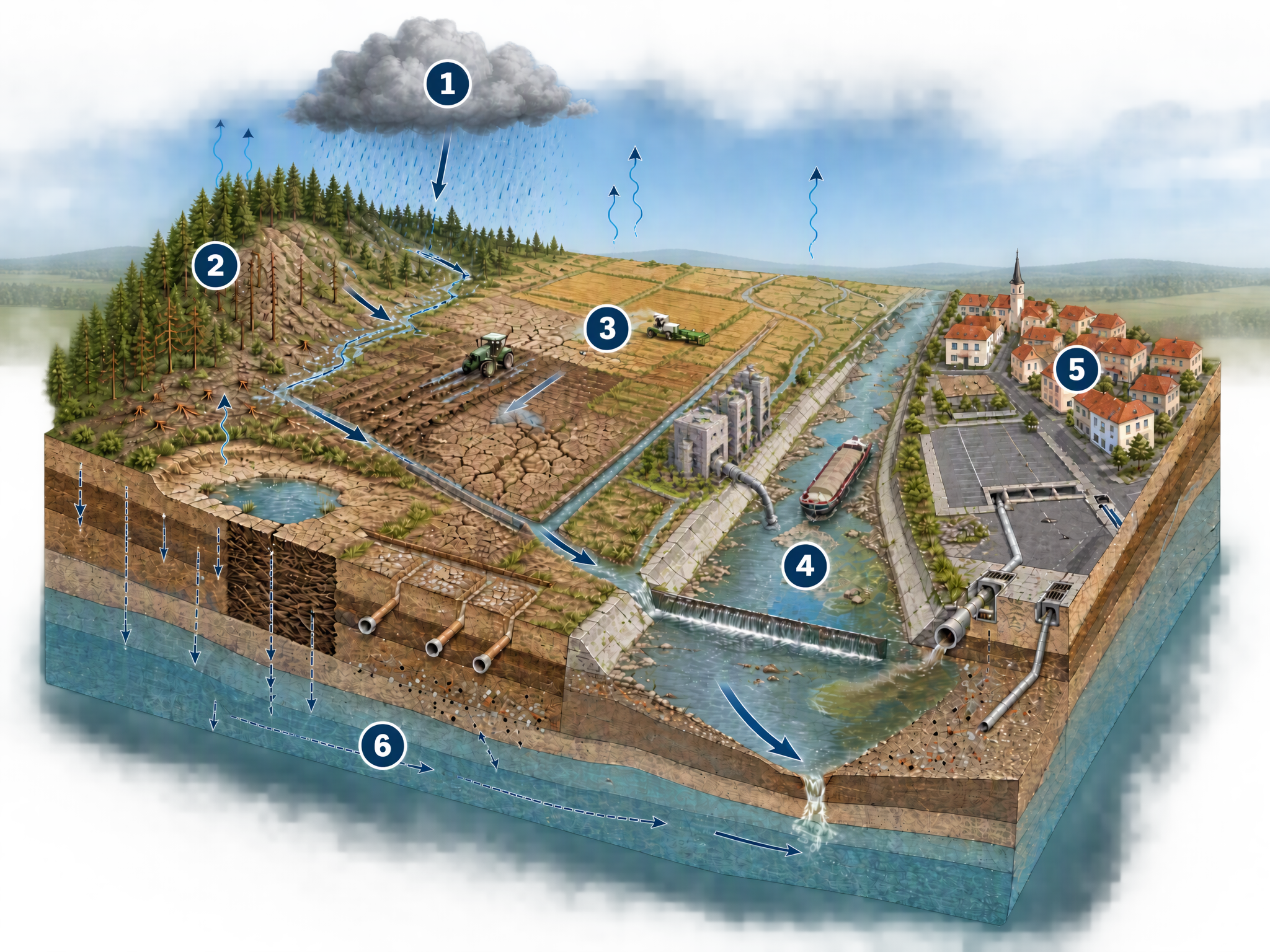
Illustration: AI-generated, edited by Stefanie Filz
The graphic follows the water through a typical German landscape. At almost every station, water leaves faster than it should.
- Due to climate change, rain arrives in heavier bursts, separated by longer dry spells. Rising temperatures increase evaporation.
- Spruce monocultures weakened by drought and bark beetles die off, leaving soil less protected.
- Drainage pipes and ditches, once built to dry land for farming, now drain it too well. Compacted soils let rain run off instead of soaking in.
- Straightened, channelised rivers carry water away quickly and have lost much of their floodplains.
- Sealed surfaces send stormwater straight into sewers and rivers.
- Less water reaches the aquifers. Rivers fed by groundwater run lower in dry summers.
Where does resilience begin? Thinking beyond the fence line.
For companies, adapting to a changing environment remains essential. But the scale and severity of changes that we are seeing raises new questions for business leaders. If long-term resilience means thinking in natural systems, what role do the river and the forests next door play for your business? What would change if you saw your site as part of a catchment, where the water balance itself is shaped? If the causes lie in the landscape, shouldn’t the response start there too?
Bibliography
- Reuters (2026, 17 August). BASF: Lieferengpässe bei einigen Produkten wegen Rhein-Niedrigwasser. Via onvista.
https://www.onvista.de/news/2026/08-17-basf-lieferengpaesse-bei-einigen-produkten -wegen-rhein-niedrigwasser-0-20-26543800 - BASF (2023). In focus: Water. BASF Report 2023.
https://report.basf.com/2023/en/combined-managements-report/environmental-social-governance/environmental/in-focus-water.html - Douville, H., K. Raghavan, J. Renwick, R.P. Allan, P.A. Arias, M. Barlow, R. Cerezo-Mota, A. Cherchi, T.Y. Gan, J. Gergis, D. Jiang, A. Khan, W. Pokam Mba, D. Rosenfeld, J. Tierney, and O. Zolina, 2021: Water Cycle Changes. In Climate Change 2021: The Physical Science Basis. Contribution of Working Group I to the Sixth Assessment Report of the Intergovernmental Panel on Climate Change [Masson-Delmotte, V., P. Zhai, A. Pirani, S.L. Connors, C. Péan, S. Berger, N. Caud, Y. Chen, L. Goldfarb, M.I. Gomis, M. Huang, K. Leitzell, E. Lonnoy, J.B.R. Matthews, T.K. Maycock, T. Waterfield, O. Yelekçi, R. Yu, and B. Zhou (eds.)]. Cambridge University Press, Cambridge, United Kingdom and New York, NY, USA, pp. 1055–1210, doi: 10.1017/9781009157896.010.
- Swain, D. L., Prein, A. F., Abatzoglou, J. T. et al. (2025). Hydroclimate volatility on a warming Earth. Nature Reviews Earth & Environment, 6, 35–50.
https://doi.org/10.1038/s43017-024-00624-z - United Nations University (UNU) (2026). Global Water Bankruptcy Report 2026.
https://collections.unu.edu/eserv/UNU:10445/Global_Water_Bankruptcy_Report__2026_.pdf - European Environment Agency (EEA) (2025, 28 November). Water scarcity conditions in Europe. Indicator (WAT001).
https://www.eea.europa.eu/en/analysis/indicators/use-of-freshwater-resources-in-europe-1 - Güntner, A., Gerdener, H., Boergens, E., Kusche, J., Kollet, S., Dobslaw, H., Hartick, C., Sharifi, E., Flechtner, F. (2023): Veränderungen der Wasserspeicherung in Deutschland seit 2002 aus Beobachtungen der Satellitengravimetrie. Hydrologie & Wasserbewirtschaftung, 67, (2), 74-89. DOI: 10.5675/HyWa_2023.2_1
https://www.hywa-online.de/veraenderungen-der-wasserspeicherung-in-deutschland-seit-2002-aus-beobachtungen-der-satellitengravimetrie-water-storage-changes-in-germany-since-2002-from-satellite-gravity-observations
Photo: © Stefanie Filz