

Article from the Handelsblatt Journal Security and Defense
Space is an indispensable national resource whose importance extends far beyond civilian applications and is crucial for military operations. A "day without space"—that is, a day without space-based services—would have massive repercussions for the state, the economy, and society. Without satellites and their services, navigation, communication, and energy supply, among other things, would collapse, and military operational and command capabilities would be severely impaired.
The CIR branch of the armed forces assumes an important role
In light of growing threats and technological developments, the German Armed Forces must address these challenges and adapt to the future. The German government's first space security strategy, published in November 2025, outlines guidelines and defines the foundation for a networked, resilient overall space architecture for the German Armed Forces until 2029 and beyond.
A key function here is operational support from space, encompassing communication, navigation, Earth/weather observation, and global imaging reconnaissance. The Cyber and Information Domain Service (TSK CIR), acting as the "eyes, ears, and central nervous system of the armed forces," consolidates these core services and provides them to the Bundeswehr in a unified manner.
With responsibility for operating the German Armed Forces' satellite systems and supplementing them with services from civilian satellite operators, the TSK CIR (Combat Intelligence and Information Technology Service) assumes a key role. This role is complemented by the further development of the systems and the overall architecture. To integrate the existing systems and their services into a combat-ready space infrastructure, a target architecture for the overall architecture of future operational support from space was developed. This target architecture is based on a paradigm shift from a project-based approach to a program-oriented, rolling procurement model. This model envisions a transition from lengthy procurement projects for a few high-value satellites to a program-oriented approach with the rolling procurement of satellites of various sizes and price ranges.
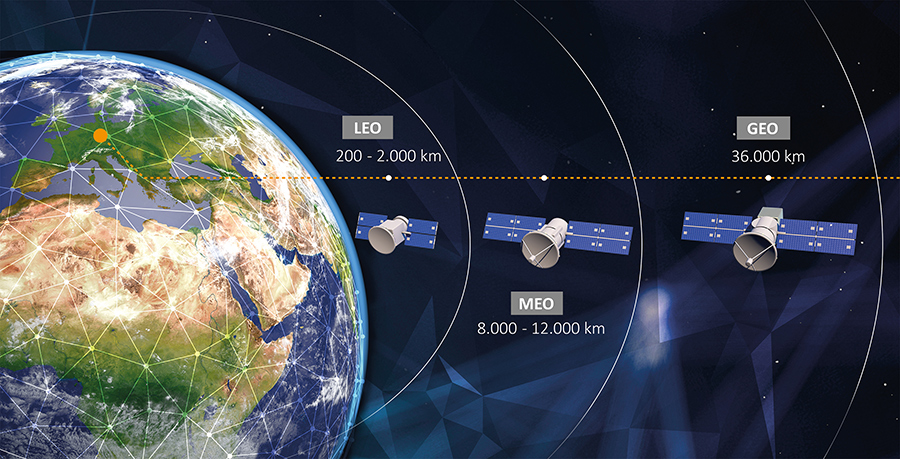 Multi-orbit structure in LEO (Low Earth Orbit), MEO (Medium Earth Orbit) and GEO (Geostationary Orbit)
Future-oriented approach through multi-orbit architecture
In the future, it will be necessary to adapt flexibly to increasing demands regarding networking, flexibility and responsiveness in order to remain resilient and functional even in a disrupted space environment due to additional satellites.
By 2029, a hybrid multi-orbit structure is planned for space, utilizing multiple orbital planes to ensure maximum flexibility, coverage, and reliability. A mesh topology with dynamically adaptable networking will enable global coverage, reduced latency, and enhanced resilience with high availability. For global imaging reconnaissance, a combination of several larger satellites for high-resolution images and numerous smaller satellites is planned. The latter will be usable for both imaging and signal-gathering reconnaissance. This multi-orbit architecture forms the core of a system that remains operational and reacts quickly even under degrading conditions.
Technological innovations are crucial
Technological progress is also reflected in the consistent use of optical inter-satellite links: a technology developed in Germany that enables both intra- and inter-orbital connections with high data rates and increased protection against eavesdropping and interference.
These technologies are crucial for transmitting mission-critical data with minimal delay while maintaining security. In an increasingly complex security environment with active threats in space, the overall architecture provides a robust foundation for effectively addressing potential conflicts.
Close control by the Combat Intelligence and Security (CIR) branch and the implementation of innovative space technologies will significantly expand the operational spectrum of the German Armed Forces and contribute to ensuring reconnaissance, communication, and command and control even in challenging scenarios. The investment of approximately €35 billion by 2030 in space and space security reaffirms the political will to make Germany a resilient and sovereign space actor.
Photo: © German Armed Forces/Stefan Uj