
Artificial intelligence is advancing at record speed. New models and applications are emerging almost weekly, and the technology is set to transform not only industries but societies as a whole. Few doubt its relevance anymore: AI will change how we do business, how products are designed, how factories run, how supply chains are managed, and how daily work is organized.
The technological challenge – how to develop AI – is increasingly solved. The greater challenge now is integrating AI into existing systems and processes at scale. Just because AI is the newest breakthrough does not mean industries can start from scratch. Legacy systems, established businesses, and traditional industries must all be brought into the new age of AI.
Europe, with some of the world’s oldest and most established industrial economies, faces this challenge especially acutely. The question is not whether AI matters, but how to adopt it quickly, reliably, and with measurable value. One answer comes from the Nordics. In 2015, a group of industrial leaders founded Combient, a cross-industry alliance designed to help companies transform together.
Combient: A Nordic Success Story
The origins of Combient trace back to Stockholm. In 2014, Marcus Wallenberg, head of one of Europe’s most influential industrial families, and me, Mats Agervi, then an Ericsson executive, asked a pressing question: How could Europe’s century-old industrial companies Keep pace with technology moving at startup speed? And we knew we could go much further if the Nordic Industry worked together.
Within months, eleven major industrial players, including Atlas Copco, Ericsson, and Electrolux, signed on to an unprecedented experiment: a cross-industry network where non-competing enterprises would share knowledge, assets, and work collaboratively. In January 2015, Combient was founded.
Today, the network comprises 36 associated companies across various industries with a total turnover of €280 billion and more than 1,400,000 employees. The idea remains simple and effective: by pooling resources and knowledge, companies can adopt new Technologies faster and with less risk than they could alone. That this took root in the Nordics is no accident: Small countries, flat hierarchies, and a long tradition of cooperation have made collaboration the default. Elsewhere in Europe, however, building this trust may prove more challenging — but precisely for that reason, it is worth working on, as it could become Europe’s unique competitive advantage.
Europe’s Challenge: Adoption at Scale
Europe’s companies are global leaders in manufacturing, logistics, energy, and engineering. However, when it comes to AI, the gap lies in the speed of adoption. Too often, promising pilots never move beyond proof-ofconcept. Projects get stuck in procurement cycles, IT roadmaps, or integration hurdles. Corporate structures built for reliability and compliance slow down implementation.
A further difficulty is deciding which projects are worth scaling. Many companies launch dozens of pilots without a clear way to separate experiments from initiatives with real business impact. Without that discipline, momentum is quickly lost.
This is particularly relevant in Germany. The Mittelstand – with its thousands of hidden champions – forms the backbone of the economy. Unlike large multinationals, many of these firms have fewer resources to scout technologies worldwide or run multiple pilots in parallel. Yet their niche markets depend on staying at the forefront of innovation. For them, finding ways to share knowledge and pool resources could make the difference between experimenting endlessly and actually adopting the best AI technologies.
Venture Client: A Different Model of Adoption
One answer to the adoption challenge comes from Germany itself: the venture client model. Developed at the BMW Group and since adopted across Europe, it gives companies a faster route into new technologies. Instead of lengthy procurement or equity investments, firms become a startup’s first customers. They test solutions directly on real business problems, then scale those that prove effective.
Combient added a collaborative layer to this model and created Combient Foundry, a venture client alliance, where members jointly scout, test, and adopt solutions from the global startup ecosystem.
On its own, the venture client model helps cut through internal bottlenecks. In an alliance, it goes further. Companies can coordinate scouting, compare experiences from pilots, and learn from each other’s mistakes as well as successes. For Mittelstand firms, in particular, such a setup can provide access to startups and insights they would struggle to gain alone.
Neutral governance and shared rules of engagement foster the trust that enables such collaboration across companies, industries, and borders.
Practical Case – The Generative AI Cycle
How this works in practice became visible in 2023, when Combient Foundry launched a four-month program focused on generative AI. Nine companies across the alliance defined 38 use cases, identified and vetted more than 600 startups, and initiated 24 follow-ups. Proof that the model can move adoption beyond isolated pilots.
Some of these collaborations have grown into longer-term partnerships. Scania and Applied Intuition, for example, are now working together on next-generation vehicle testing with AI. Atlas Copco and Ekkono have extended an initial Project into a partnership on edge machine learning in industrial equipment. With new members such as Traton Group and Kion Group, the venture client alliance has now reached Germany.
Collaboration as Europe’s Path Forward
For industry, scale in AI comes not from building ever-larger models, but from more companies working on more use cases, learning faster, and sharing insights. Alliances make this possible: they attract strong startups, validate solutions more effectively, and accelerate Integration into operations.
Every pilot, whether successful or not, contributes to a collective learning curve that benefits all participants. This exchange creates the framework companies need to determine which cases can scale and how to calculate their return on investment.
The Nordic experience demonstrates that this approach is effective in practice. And with companies like Traton and Kion now joining, the alliance model is spreading further into Europe.
Europe will not build a Silicon Valley of its own – but it can create a model that nobody else has: Trust as an industrial policy and collaboration as the way forward.
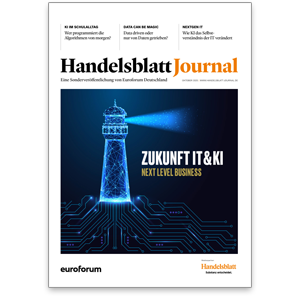
„Zukunft IT & KI“ erschienen. Das vollständige Journal können Sie sich hier kostenlos herunterladen: