
Munich wore the easy warmth of a summer evening. After an intensive working session, Adaptation Exchange members crossed the city for something lighter, a relaxed get-together at the Max & Moritz Social Club, where the team welcomed us warmly and a wider circle of guests invited by the Handelsblatt was already gathering. A fresh soda spritz, Mediterranean platters, the first conversations underway before anyone had even sat down: the evening could happily have carried on just like this. But we had brought a question with us, the same one that gave the evening its name. Climate resilience in companies: a CEO matter, a cross-cutting task, or both?
The group was small by design and strikingly diverse. People had come from finance and banking, from industry and start-ups, from investing, software and professional services. “A powerhouse of an adaptation network,” as one guest put it. Among them were a good number of young companies building the field in real time, cooling clothing, wildfire prevention and analytics, forecasting, climate risk data. Before anything else, people simply found one another, and they found one another fast.
Our earlier roundtables had turned on other faces of adaptation, from assessing climate risk along the value chain, agreeing on a common “resilience” language, to making the investment case that must hold up beside every other call on the budget. This time, the questions of mandate and of change moved to the centre. Because without a clear responsibility, even the strongest efforts stay isolated. With that, we turned to the panel.
We run these evenings under the Chatham House rule, and that matters, especially now. Adaptation is in a phase of shared development and common learning, and honest exchange needs a room where people can speak freely. So, the stories below travel without the names of those who told them.
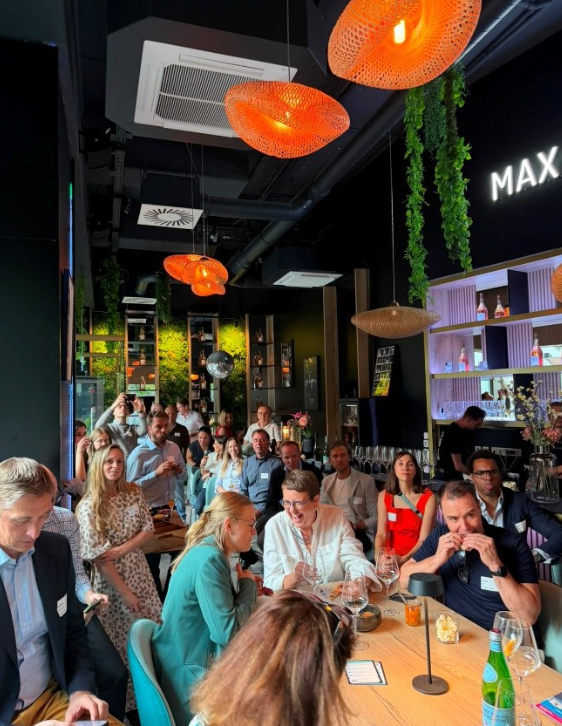
A short panel, followed by broad discussion
Our two panellists, Katinka Barysch of Allianz SE and Dr. Florian Feigs of BASF Agricultural Solutions, are – in their respective positions – closely involved in corporate climate adaptation.
They highlighted that the first step to effective adaptation action is to understand the risks, which means relying not only on past data of the impact from extreme weather events but also forward-looking climate scenarios; then adding details of where factories, fields, suppliers are most exposed and what is the value at risk.
Research and testing are equally important for finding out what works in terms of adaptation, be it through growing more resilient crops in a laboratory or operating testing sites for how to flood-proof a building. This is the important step to translate climate data into understanding the impact they could have. The most vulnerable elements of a building or a crop could then become the specific area of product development.
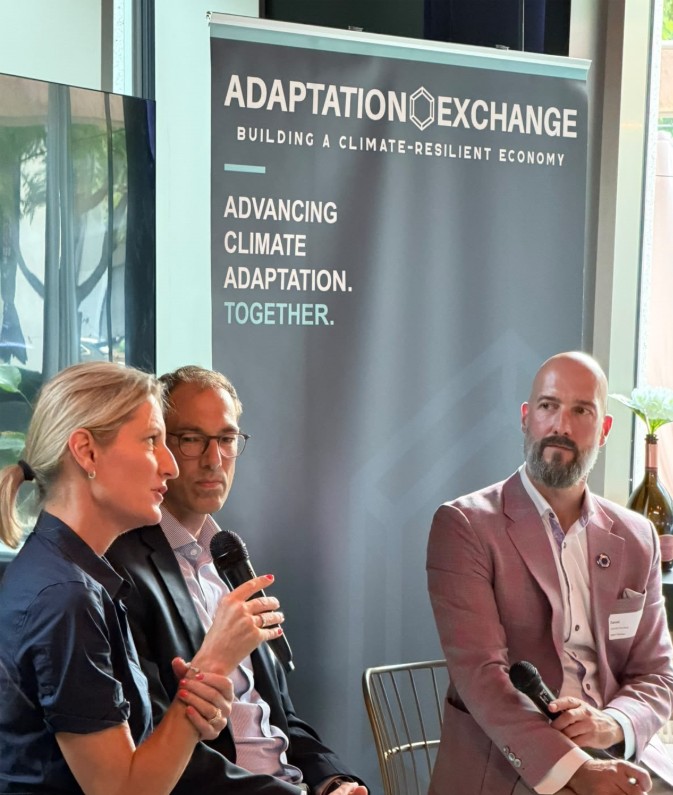
From concrete examples of what works, the talk turned to investment needs. Our panellists highlighted that it is important for companies to understand that adaptation investments are not something that is fundamentally new. Translating financial needs and implementation actions into the language that colleagues understand can be an important first step: business continuity, supply chain diversification, energy security, enterprise risk management, occupational health and safety –they can all have adaptation components. Quantification of business loss without an investment is nothing new but this is only one side of the join. Which value can an investment into climate adaptation bring is the tricky question.
It is crucial to reframe adaptation from a cost to an investment into value. Lost crops, disrupted supply chains, unplanned shutdowns – they can all entail enormous losses. It is, therefore, possible to define an investment case for preventing such events that can compete with other capital needs. Investments into fixed assets are often done for more than a decade, sometime even up to 30-40 years. In order to ensure business continuity, the mid or long future, the climatic condition then is needed to consider.
An intervention from the room made this point poignantly: A site leader was asked a simple question: “knowing today’s climate scenarios, would they build a certain factory again, on the very same ground”? The answer was a clear and immediate “no”
Understanding risks, prevention measures and investment cases is one thing. Integrating them into an adaptation strategy and getting this implemented across the company and consistently for years, is quite another. With that, we arrived at the question the evening was named after: who is responsible and how can companies get to effective implementation?
The mandate from the top should not be underestimated, said our panellists. Given that climate risk increasingly shapes the future of a successful business and requires both organizational transformation and investment, both CEO and CFO must be involved.
Panellists highlighted that for companies it was key to assemble a variety of functions – from finance to risk management, operations, procurement and HR — around adaptation as a strategic topic that is both transformative and transversal.
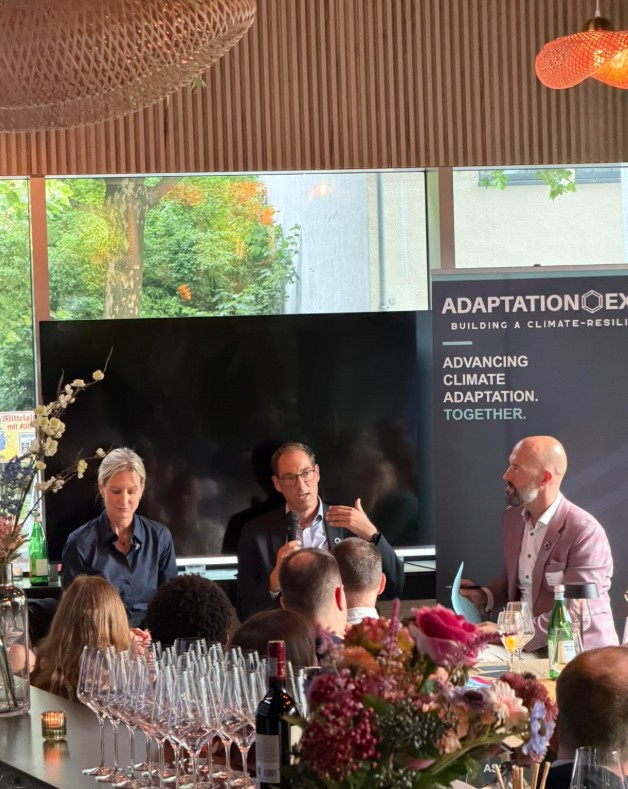
Collaboration cannot, however, stop at the company gate or even at the value chain. Public actions for, and investments in, adaptation is a precondition for success. Companies must therefore work with governments and communities so that adaptation becomes a joint objective. Governmental support is needed for e.g. larger investments that might not have a positive business case under current conditions but are needed to remain in business in 15-20 years. Only when companies and consumers invest, new business models can be adapted.
When Daniel Schmitz-Remberg, moderator and founder of the Adaptation Exchange, opened the floor, the room took over. We had kept the whole evening interactive, and here it came to a head around a question we had also put to the room in Paris lately: what actually moves a company further on adaptation, the best story or the most rigorous business case? We ran a live vote. The room came down roughly sixty to forty for the story, and then one participant landed the line of the night.

From there the conversation kept opening. A banker described the many KPIs his institution already collects because regulation demands them, their real use still an open question. Others wished for firmer ground from policy: the clarity France created by fixing a plus-four-degree scenario, say, and a public commitment to urban resilience. What they were after was direction rather than another CSRD-style reporting regime. After all, no single company can build its own dike, and once you see it that way, adaptation becomes a shared, societal project.
What took shape
By the end, the evening had answered its own question. Is climate resilience a matter for the chief executive, or a task that cuts across the whole company? Both, and that is the honest answer rather than a diplomatic one. It needs a mandate from the top, the kind only the leadership can grant. German has a lovely word for it, “Chefsache”, the boss’s own business. And it needs to live in every function at once, sustainability with operations, finance with risk, procurement with the supply chain, because no single owner can carry it alone. The two are really one. A mandate with no cross-functional muscle stays a slogan, and cross-functional energy with no mandate rarely finds the money or the authority to change very much. Global Sustainability units are best positioned to keep the oversight of the different measures being implemented and report progress based on materiality.
Around that answer, the room kept circling a few conditions. A shared language, so that risk can move freely between finance, sustainability and operations. Scenarios with real force, built into how a company plans and invests, so that foresight guides the decisions. The right people at the table, including partners well beyond the company’s own walls. And a steadying hand from the public sector, so that resilience becomes a common project. These are exactly the threads the Adaptation Exchange is working through its three groups: a stack of solutions that already work, a business case that earns adaptation a fair claim on capital, and an assessment that gives everyone a shared language to begin with.
Until the next glass
The evening closed much as it opened, a glass in hand and conversations no one wanted to end. There was even a wine tasting planned for afterwards, and not a single person went, because everyone still had far too much to say to each other. That, more than anything on the agenda, told us it had worked. We came away with a clearer answer than we arrived with, and a room full of people who mean to keep testing it together. That is what the Adaptation Exchange is for: a trusted place where very different experts listen, speak up, and share the same drive to move adaptation forward. Together.
Which brings us back to the question we came in with. A matter for the chief executive, a task across the whole company, or both? Both, held together, and that is what turns adaptation from a topic into a decision, and a decision into transformation.